
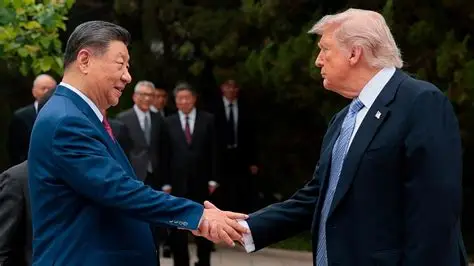
U.S. President Donald Trump and Chinese President Xi Jinping have held a closely watched meeting in Washington as the relationship between the world’s two largest economies remains shaped by trade, technology, security and competing geopolitical interests.
The meeting brought together the leaders at a time when Washington and Beijing are attempting to manage disagreements without allowing individual disputes to trigger a broader deterioration in relations. Trade remains one of the most visible areas of competition, with tariffs, market access and supply chains continuing to influence relations between the two countries.
Technology is another central issue. Artificial intelligence, advanced semiconductors and computing infrastructure have become strategic areas for both governments. The United States has imposed restrictions on the export of some advanced technologies to China, while China has accelerated efforts to develop domestic alternatives. The outcome of discussions between the two leaders is therefore being watched closely by technology companies and manufacturers around the world.
Taiwan is also a longstanding source of tension. Beijing considers Taiwan part of China, while the United States maintains extensive unofficial relations with Taipei and has continued to provide support. Any deterioration over Taiwan could have consequences for regional security and global markets.
The leaders’ discussions also come against the background of conflicts elsewhere, including the confrontation involving Iran and the United States and the war in Ukraine. China maintains important economic and diplomatic relationships with Russia and Iran, making Beijing relevant to several international crises simultaneously.
For other governments, the summit matters because the relationship between Washington and Beijing affects far more than bilateral trade. Decisions concerning tariffs, technology controls, investment and security can influence global supply chains, commodity prices and the policies of allied and partner countries.
The summit does not remove the structural differences between the two governments. Instead, it demonstrates the continuing importance of direct communication between them. Even when major disagreements remain, regular high-level contact can provide a channel for managing crises.
Businesses are particularly interested in whether the meeting produces concrete agreements or simply reduces tensions temporarily. Manufacturers have spent years adjusting supply chains because of uncertainty surrounding U.S.-China relations. A more stable relationship could make investment planning easier, while renewed restrictions could accelerate the movement of production into other markets.
The meeting is therefore significant both diplomatically and economically. Its long-term importance will depend on what follows the summit: whether agreements are implemented, whether disputes re-emerge, and whether Washington and Beijing can maintain communication over the issues on which they continue to disagree.
The gathering is another indication that U.S.-China relations remain one of the most consequential relationships in international politics, affecting security, technology, trade and the global economy.