

Take a quick look at any QR code and you will notice something interesting, it has three large squares positioned at three of it’s corners while the fourth corner is left without one. It’s a design detail most people overlook, yet it’s one of the reasons QR codes can be scanned so quickly and accurately.
So, why three squares instead of four ? The answer lies in smart engineering
The Three Squares Are Finder Patterns
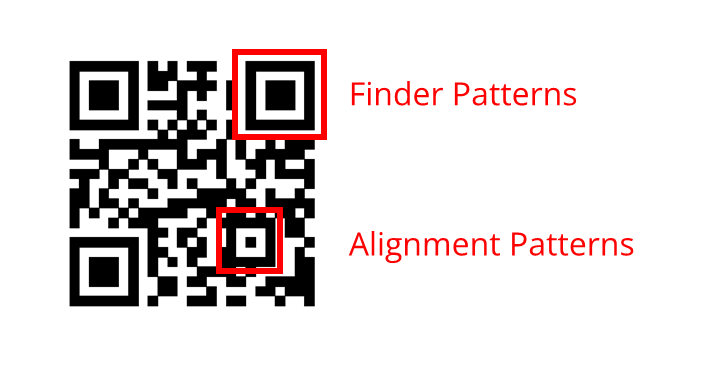
The primary job of the three squares is to help a scanner or smartphone camera instantly recognize that it is looking at a QR code.
These finder patterns allow the scanning software to determine :
- Where the QR is located.
- It’s size.
- It’s orientation.
- Whether it is tilted, rotated or viewed from an angle.
This means you can scan a QR code even if it is upside down or sideways, and your phone will still read it correctly within seconds.
Why Not Add a Fourth Square
At first glance, adding a fourth square might seem like it would improve accuracy. In reality it would create confusion.
With four identical corner markers, the scanner would have a harder time determining the correct orientation of the code. The software world need extra processing to figure out which corner is which, making scanning slower and less efficient.
Using only three finder patterns creates unmistakable layout. The scanner immediately knows which way the code is positioned, allowing for faster and more reliable decoding.
What’s in the Fourth Corner?
Instead of another large finder pattern, the fourth corner contains smaller components that helps improve accuracy.
One of these is the alignment pattern, a smaller square that helps the scanner compensate for distortion. If a QR code is printed on a curved bottle, bent piece of paper, or uneven surface, the alignment pattern helps the software map the code correctly.
Larger QR codes may contain several alignment patterns distributed throughout the code to improve readability.
Timing Patterns Keep Everything in Line
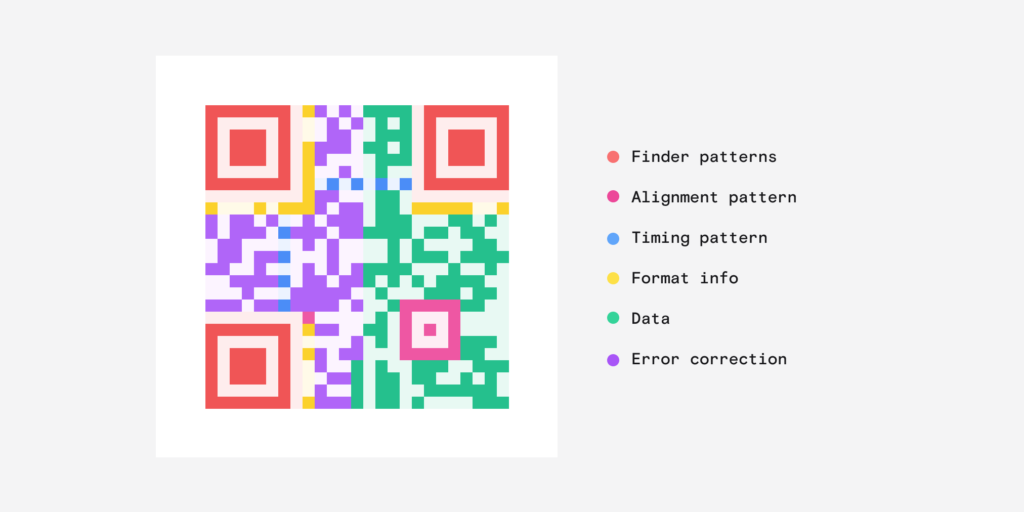
If you look closely between the finder patterns, you’ll notice alternating black and white modules (tiny squares). These are called timing patterns.
Their purpose is to help the scanner determine :
- The size of each tiny square.
- The spacing between rows and columns.
- The overall grid structure.
Without timing patterns, the scanner would struggle to identify individual data cells accurately.
Built to Handle Damage
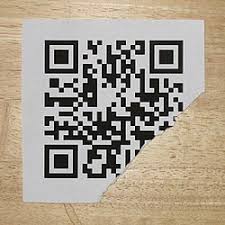
Another impressive feature of QR codes is their ability to remain readable even when partially damaged.
Thanks to built-in error correction, QR code can often still be scanned if part of it is still scratched, dirty or covered by a logo. Depending on error correction level used, QR code can recover from significant data loss while remaining functional.
This is why many companies safely place their logos in the center of QR codes without affecting performance.
A Design That’s Been Around For Decades
QR codes were invented in 1994 by Masahiro Hara and his team of the Japanese company Denso wave. They were originally designed to track automotive components during manufacturing.
The three-pattern-finder design has remained virtually unchanged because it works so well. Today billions of QR codes are scanned every year for payments, restaurant menus, event tickets, product information, marketing campaign and secure logins.
The Genius Behind The Simplicity
What appears to be a simple arrangement of black and white squares is actually a carefully engineered system. Every element from the three finder pattern to timing and alignment patterns has a specific pattern that enables fast, reliable scanning under a wide range of conditions.
The next time you scan a QR code, take a moment or notice these three distinctive corner squares. They are not just decoration, they are key to making one of the world’s most widely used technologies work effortlessly.
Final Thoughts
The reason QR codes have three corner squares instead of four is simple : three provide all the information needed for quick orientation, while avoiding the ambiguity that four identical corner markers would introduce. Combined with alignment patterns, timing patterns and built-in error correction, this elegant design has stood the test of time and continues to power countless digital interactions around the world.