
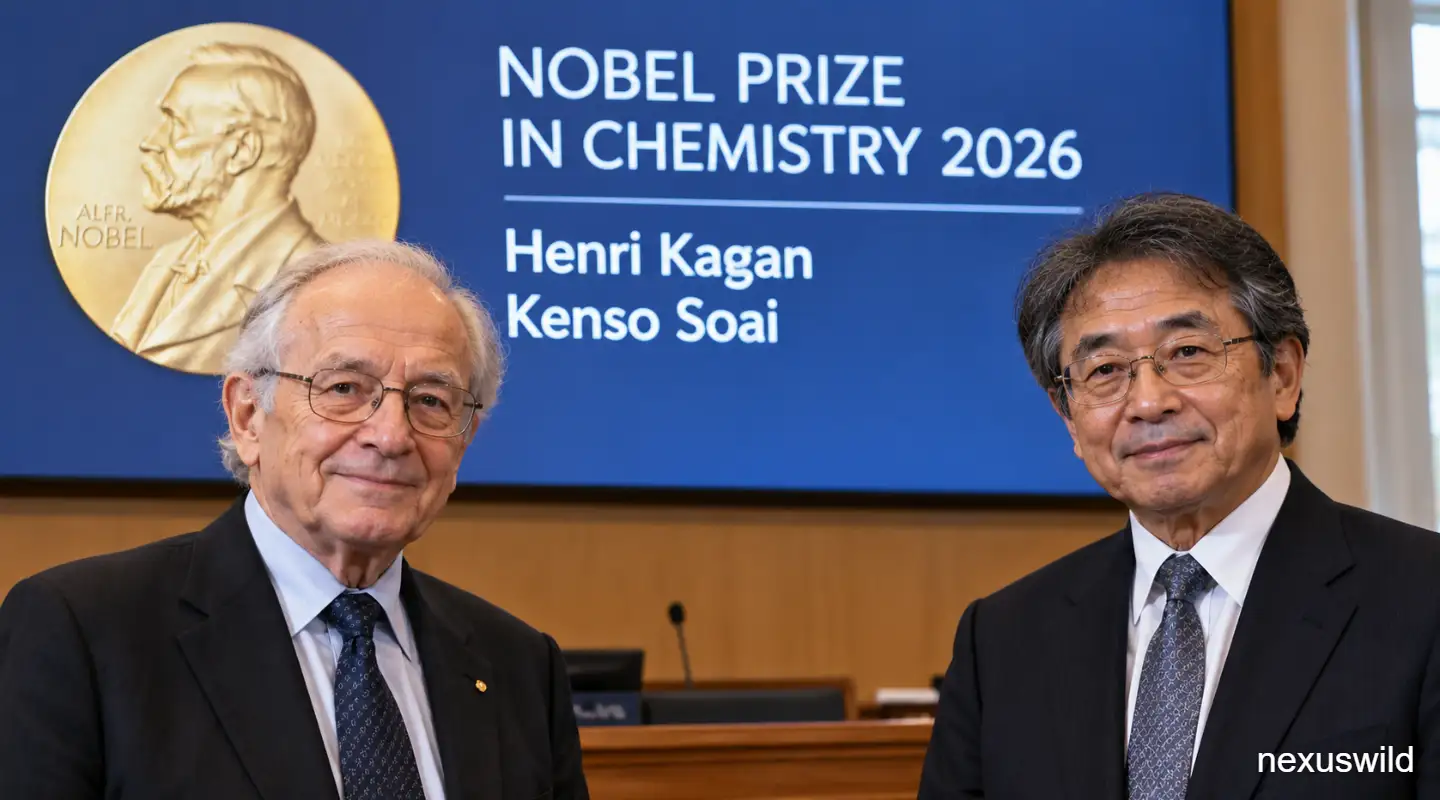
The 2026 Nobel Prize in Chemistry has been awarded to French scientist Henri B. Kagan and Japanese scientist Kenso Soai for their discovery of non-linear effects and autocatalysis in asymmetric organic synthesis, the Royal Swedish Academy of Sciences announced on Wednesday, October 7, 2026.
The two scientists, aged 95 and 76 respectively, were honoured for solving a century-old chemical mystery: how homochirality—the existence of only one mirror-image form of a molecule in living organisms—can emerge spontaneously . They will share the prize sum of 12 million Swedish kronor (approximately $1.2 million) equally.
The Mirror Image Mystery
Many molecules essential to life, such as amino acids, exist in two variants that are non-identical mirror images of each other, much like a left and right hand . While both forms can exist, living organisms almost exclusively use only one of them in their proteins and cells—a phenomenon known as homochirality . When chemists attempted to replicate these molecules in the laboratory, they invariably produced an equal mixture of both mirror images . The question of how this chemical asymmetry could arise spontaneously had puzzled scientists for over a century .The implications are particularly significant for pharmaceuticals. As the Nobel Foundation explained, many drug molecules occur in two mirror-image variants: one has the therapeutic effect, while the other can cause unnecessary and sometimes harmful side effects . The ability to selectively produce only the desired form is therefore crucial for drug development.
From Discovery to Breakthrough
Henri Kagan took the first decisive step in 1986, when he discovered non-linear effects in asymmetric catalysis. His work showed that it was possible to create a greater excess of one mirror image than had previously been thought achievable . Kenso Soai advanced the research further. In 1995, he designed the first chemical reaction with the potential to be homochiral, and in 2003, he achieved the feat: a reaction that produced only one of the two possible mirror images from a non-chiral mixture . According to the Nobel Committee, apart from life itself, no one had previously accomplished this .“Henri Kagan and Kenso Soai have provided a solution to a chemical mystery that is over a century old: how homochirality can emerge spontaneously,” said Heiner Linke, chair of the Nobel Committee for Chemistry. “The chemical reactions they have developed are spectacular” . The committee noted that their discoveries “have been decisive for chemists who design reactions for the manufacture of pharmaceuticals”.
The Laureates and Their Reactions
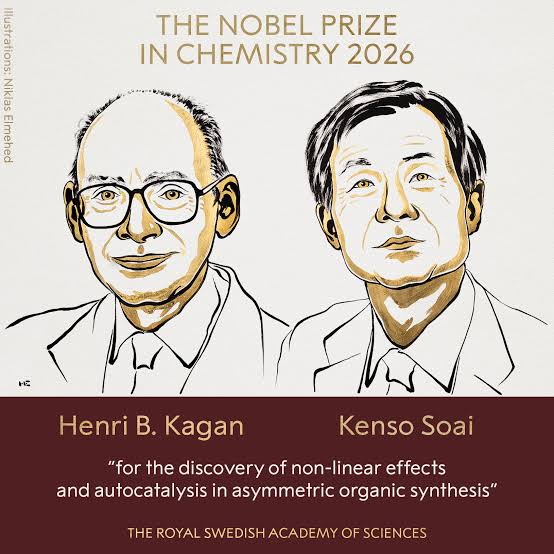
Henri B. Kagan, born in 1930 in Boulogne-Billancourt, France, is professor emeritus at the former Université Paris-Sud. He earned his doctorate in 1960 at the Collège de France and is considered one of the leading pioneers of asymmetric catalysis in organic chemistry . Kenso Soai, born in 1950 in Hiroshima, Japan, is professor emeritus at the Tokyo University of Science. He received his PhD from the University of Tokyo in 1979 and joined Tokyo University of Science in 1981 . The reaction he developed is widely known as the “Soai Reaction” and is regarded as one of the most spectacular chemical experiments ever performed .Soai, who was out shopping near his home when he received the news, said: “I’m very excited to receive the very nice news about Nobel Prize. Of course, this is the most exciting day, one of the most exciting days in my life” .
At a press conference at Tokyo University of Science, he added: “I am very glad to share this prize with professor Henri Kagan” . This marks the third consecutive year with a Nobel Prize winner from Japan, and Soai becomes the 31st Japanese individual to receive a Nobel Prize . The awards ceremony will be held in Stockholm on December 10, the anniversary of Alfred Nobel’s death.