
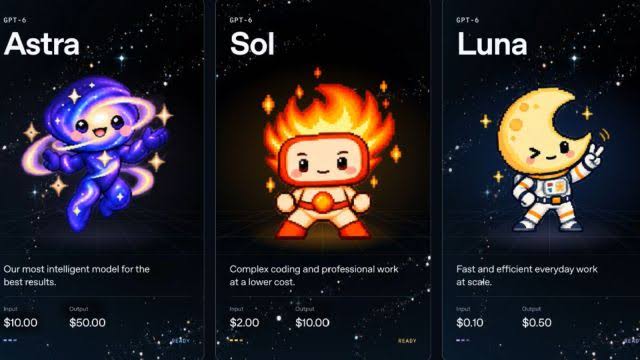
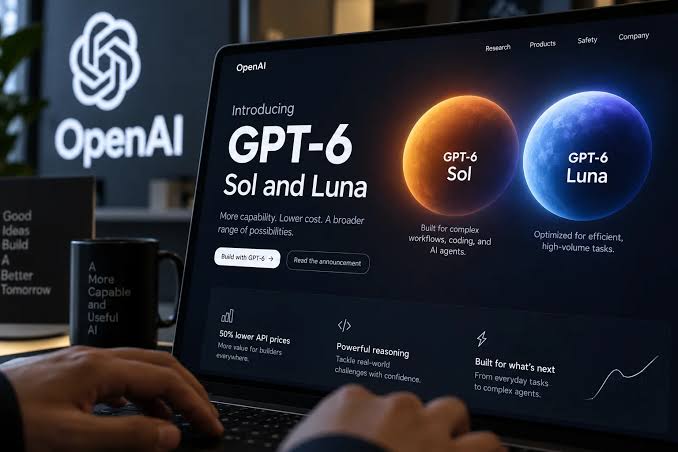
OpenAI unveiled GPT-6 Sol and GPT-6 Luna on Tuesday, September 22, 2026, two efficiency-focused models that deliver roughly half the operating cost of their predecessors while substantially reducing factual errors.The release arrived just 90 minutes after Anthropic launched Claude Opus 5.5, signaling an intensifying price war among frontier AI laboratories . Sol is positioned for complex coding and agentic workflows, while Luna targets high-volume, focused tasks, with both models inheriting key advances from the flagship GPT-6 Astra that debuted earlier in September .
Pricing That Reshapes the Economics of AI Deployment
The price reductions are substantial. GPT-6 Sol costs $2 per million input tokens and $10 per million output tokens, while GPT-6 Luna is priced at $0.10 input and $0.50 output, representing a 50 percent reduction from GPT-5.6 promotional rates . Both models feature a 1.05 million token context window and support text and image inputs, with prompt caching offering a 90 percent discount on cached reads. Independent analysis from Artificial Analysis found that GPT-6 Sol costs $1.06 per task to run their Intelligence Index, approximately 50 percent less than GPT-5.6 Sol at $1.99, while Luna costs just $0.07 per task, roughly 60 percent cheaper than its predecessor .
Performance Gains and Trade-offs
Beyond cost, the most significant improvement is in factual reliability. On Artificial Analysis’s hallucination benchmark, GPT-6 Sol cut its hallucination rate from 92 percent to 60 percent, while Luna reduced its rate from 93 percent to 77 percent . Sol achieves this partly by declining to answer more often—attempting 83 percent of questions versus 99 percent for GPT-5.6 Sol—which reduces wrong answers by about a quarter but also lowers overall accuracy from 59 percent to 54 percent . On AutomationBench, Sol scored 33.2 percent at xhigh effort with a cost of $0.27 per task, outperforming Claude Opus 5 at maximum effort (26.9 percent) while costing approximately 9 percent of Opus 5’s $1.28 per task . However, not all metrics improved: both models regressed in GDPval-AA v2.1, a benchmark of economically valuable tasks across 44 occupations, with Sol dropping roughly 100 Elo points .
Availability and Strategic Positioning
GPT-6 Sol and Luna are now available in ChatGPT Work and Codex for Plus, Pro, Business, Enterprise, and Edu users, while Free and Go users can access Luna in the desktop app. Notably, neither model is available in standard Chat mode yet, and Enterprise administrators must enable them . OpenAI also omitted a Terra-tier model from the GPT-6 lineup, consolidating around three tiers: Astra (flagship), Sol (professional), and Luna (high-volume) . The company described the new models as “advancing the frontier on cost efficiency” while distributing “the benefits of that intelligence” to faster, more affordable offerings . With five frontier-class model releases in ten days across OpenAI, Anthropic, and xAI, the competitive pressure is clearly reshaping the AI landscape—and cost per task, not just peak benchmark performance, is becoming the decisive metric for enterprises deploying AI at scale .