


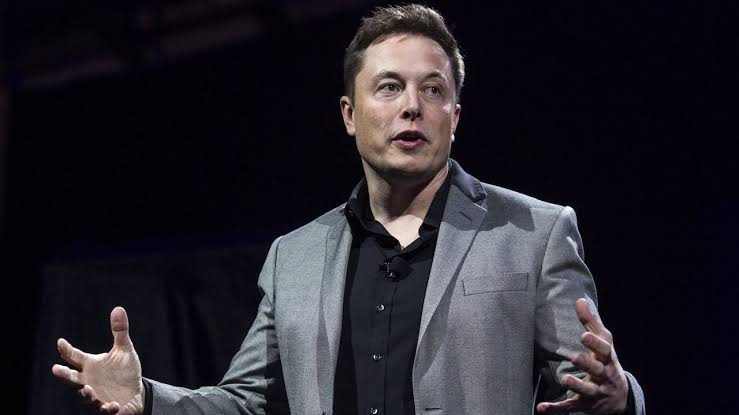
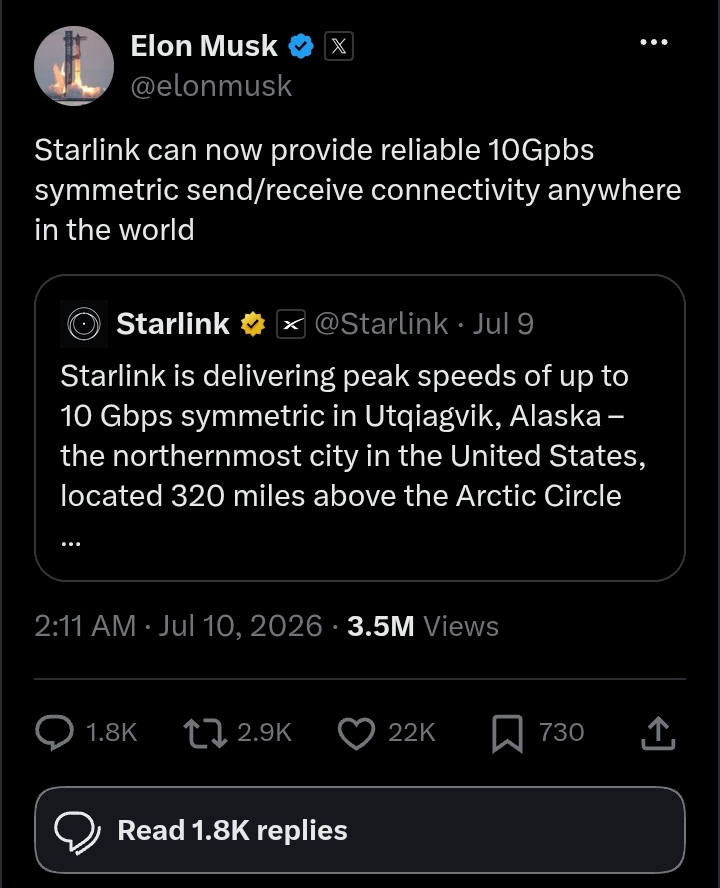
SpaceX CEO Elon Musk has made one of his boldest connectivity claims yet, announcing Starlink can now provide 10 Gigabit-per-second (10Gbps) symmetrical upload and download speeds anywhere on earth. If realized at scale, the milestone would represent a major leap for satellite Internet, bringing fibre-like performance to some of the world’s most remote locations.
Musk’s Announcement
The announcement followed a Starlink demonstration in Utqlagvik, Alaska, the northernmost city in the United States. According to Starlink, the network achieved peak symmetrical speeds of 10Gbps, while it’s bonded gateway technology is capable of delivering up to 20Gbps in remote and extreme conditions. Elon Musk the stated on X that Starlink that can now provide “reliable 10Gbps symmetrical send/receive connectivity anywhere in the world.”
Why It Matters
Satellite internet has traditionally been associated with slower speeds and higher latency than fibre-optic networks. Starlink’s low-Earth orbit (LEO) satellite constellation has already changed that perception by offering low latency and faster broadband than previous satellite services.
If 10Gbps become widely available, it could benefit ;
- Remote communities with limited broadband infrastructure.
- Businesses operating in isolated regions.
- Military and government communications.
- AI powered applications requiring high-bandwith connections.
- Emergency responders and disaster relief teams.
Starlink’s Rapid Expansion
The announcement comes after Starlink continues it’s rapid global growth.
According to recent company disclosures ;
- Starlink serves more than 10 million subscribers worldwide.
- The service operates in more than 160 countries and territories.
- SpaceX has more than 9,600 satellites currently in orbit.

Can Everyday Users expect 10 Gbps?
Not yet.
The reported 10 Gbps was achieved under specialized conditions. Typical residential starlink customers currently receive much lower speeds, though still significantly faster than many rural Internet options. Industry observers expect widespread multi-gigabit consumer service to depend on the rollout of Starlink’s next-generation satellites and supporting ground structures.
What’s next ?
SpaceX proposed Gen3 Starlink constellation could drastically increase network capacity, and support the company’s ambition of carrying a much larger share of global internet traffic. If regulatory approvals and satellite deployments proceed as planned, Starlink’s capabilities could expand significantly over the coming years.
Final Thoughts
Elon Musk’s claims marks another ambitious milestone for Starlink and highlights how quality satellite technology is evolving. While 10 Gbps connectivity for every customer is not yet possible, the announcement underscores SpaceX’s long-term vision of delivering high-speed low-latency Internet virtually anywhere on earth. Whether that vision becomes commonplace will depend on the successful deployment of next-generation satellites, continued infrastructure upgrades, and real-world performance at scale.